
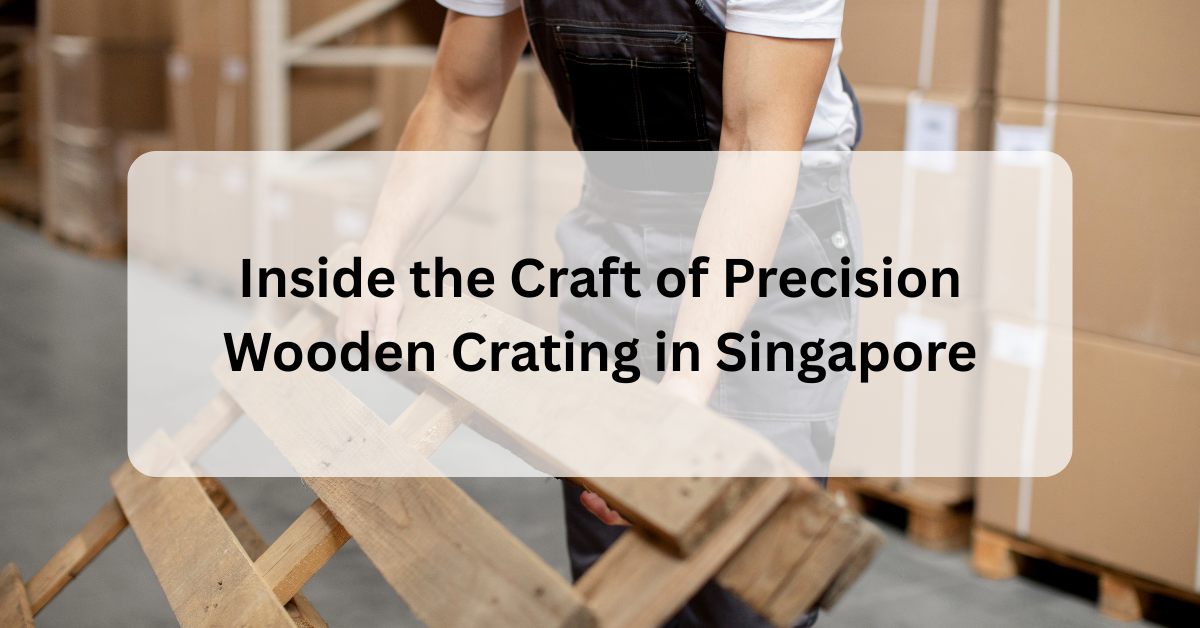

In industrial logistics, it is not the destination that determines success — it is the process that gets your cargo there safely. From fragile manufacturing equipment to oversized industrial machinery, every shipment faces vibration, impact, moisture, and handling stress before it ever reaches its final site. This is why professionally engineered wooden crates and advanced wooden crating solutions have become the backbone of safe transport for Singapore’s export and project logistics industries.
At Kaibeng, wooden crating is not mass production. It is a carefully controlled engineering process that begins with precise measurement and ends with a fully protected, ready-to-ship asset.
Why Wooden Crates Still Lead in Industrial Packaging
Modern logistics has introduced many packaging materials, but none match the structural reliability and adaptability of wooden crates. Unlike plastic or metal containers, wooden crates can be fully customised to the size, weight, and sensitivity of each piece of equipment.
For industries such as semiconductor manufacturing, aerospace, offshore engineering, and precision tooling, a millimetre of movement can lead to costly damage. This is why wooden crating remains the preferred method for high-risk cargo.
Wood offers:
- Natural shock absorption
- High load-bearing strength
- Easy reinforcement and modification
- Compatibility with export heat treatment
From Measurement to Masterpiece: How Professional Wooden Crating Works
High-quality wooden crating does not begin in a workshop — it begins with data.
1. Custom Engineering & Measurement
Every project starts with accurate cargo dimensions, weight distribution, and handling requirements. Advanced measuring tools and industrial cutting equipment ensure every wooden component fits precisely.
Each wooden block is cut to exact specifications so the final crate is not just a box, but a load-bearing structure that supports the cargo at its strongest points.
This precision prevents:
- Internal shifting
- Frame stress
- Uneven weight loading
- Structural fatigue during transport
2. High-Grade Materials for Industrial Durability
Not all timber is suitable for industrial packaging. Professional wooden crating relies on:
- Structural-grade timber
- Reinforced joints
- High-strength fasteners
- Moisture-resistant treatments
These materials ensure the wooden crates remain stable even when exposed to humidity, stacking pressure, and long sea voyages.
According to the Food and Agriculture Organization of the United Nations (FAO), wood packaging must be properly treated and manufactured to prevent biological risks and structural failures during international movement.
This is why industrial wooden crating goes far beyond simple carpentry.
3. Reinforced Joints for Handling Stress
Crates are not damaged during transit — they are damaged during handling.
Forklifts, cranes, and container stacking create torsion and impact forces that weak joints cannot withstand. Professional wooden crating uses reinforced corner blocks, cross bracing, and compression supports so the crate absorbs force instead of transferring it to the cargo.
This makes a critical difference when equipment is:
- Tilted
- Lifted by crane
- Pushed into containers
- Stacked in warehouses
4. Shock Absorption & Internal Protection
Inside a wooden crate, the most important work happens where it cannot be seen.
Custom-fitted padding, foam supports, timber blocks, and vibration-dampening bases hold the cargo firmly in place. This prevents:
- Micro-vibrations
- Impact shock
- Metal-on-wood contact
- Movement during braking or turning
This level of wooden crating ensures that even the most delicate machinery arrives in the same condition it left.
Why Singapore Exporters Rely on Wooden Crating
Singapore’s position as a global logistics hub exposes cargo to:
- Multiple handovers
- Air, sea, and land transport
- Tropical humidity
- Long dwell times at ports
Only professionally built wooden crates can maintain structural integrity across this journey.
Kaibeng’s wooden crating process is designed for:
- Export compliance
- Heavy machinery handling
- Sensitive industrial equipment
- Project cargo
Craftsmanship Meets Engineering
True wooden crating is where traditional woodworking meets industrial precision. Skilled technicians shape timber using CNC machinery, digital measuring tools, and reinforced fastening systems to ensure every crate performs like an engineered structure.
This blend of craftsmanship and technology ensures:
- Repeatable quality
- Accurate fit
- Predictable performance
- Reduced shipping risk
Why the Process Matters More Than the Box
Anyone can build a box. Only specialists can engineer a wooden crate that protects equipment through thousands of kilometres of transport.
By controlling every stage — cutting, framing, reinforcement, internal padding, and final inspection — Kaibeng ensures that wooden crating becomes a risk-control system, not just packaging.
Conclusion
High-value equipment deserves more than standard packaging. It deserves precision-built wooden crates designed by experts who understand how machinery moves, how damage occurs, and how to prevent it.
By combining advanced engineering, high-grade materials, and traditional craftsmanship, Kaibeng delivers wooden crating solutions that protect your assets — from the workshop to the world.