
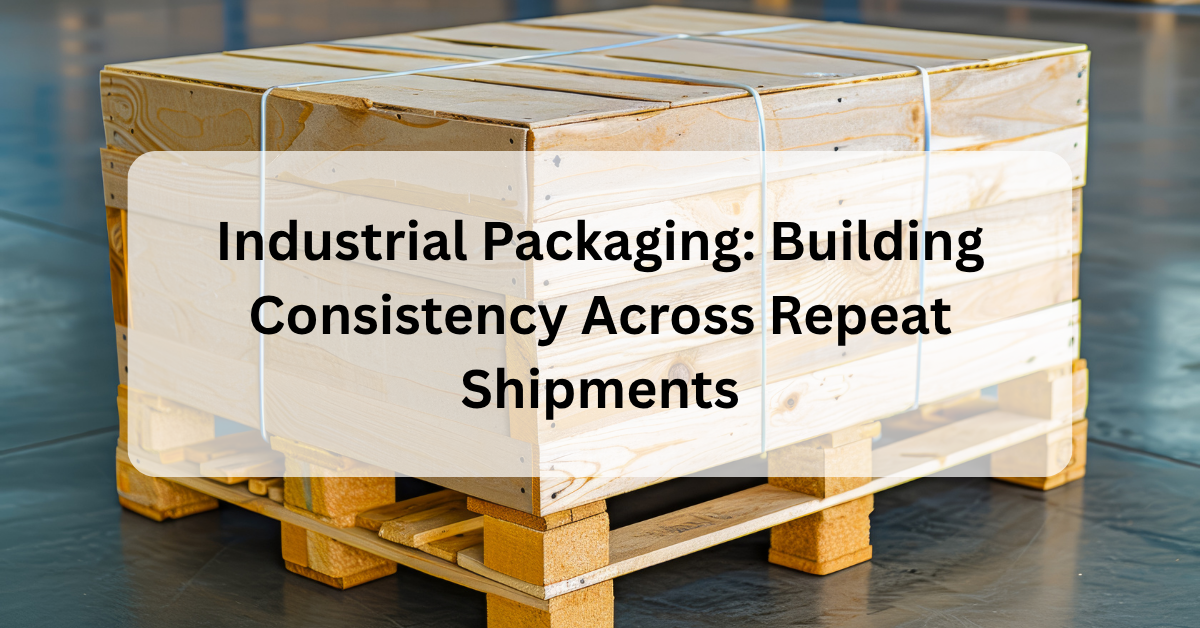

For manufacturers shipping similar machinery or components regularly, packaging is not a one-time decision. Every shipment needs to meet the same requirements, even when different employees prepare the cargo or orders are dispatched weeks apart.
Without a consistent process, small differences in packaging can lead to uneven quality, extra preparation time and avoidable rework. Industrial packaging can help address these challenges when businesses treat it as a repeatable production process rather than an individual task for each shipment.
For Singapore businesses managing recurring industrial deliveries, standardising suitable packaging procedures can improve consistency while still allowing adjustments for cargo-specific requirements.
Why Consistency Matters in Industrial Packaging
Industrial products may share similar dimensions but differ in weight, configuration or sensitivity. Even when the same product is shipped repeatedly, packaging quality can vary if the process depends entirely on individual judgement.
For example, one package may have the correct internal supports and protective materials, while another may be missing a component or use a different securing arrangement.
These differences can make quality control more difficult and increase the need for last-minute checks.
A consistent packaging process establishes clear expectations for materials, assembly, inspection and final approval. It also makes it easier for teams to identify when a shipment requires special treatment.
Create a Packaging Specification for Each Product
A practical first step is to document the packaging requirements for products that are shipped regularly.
The specification should contain enough detail for the team to prepare the package consistently without relying on memory.
Depending on the cargo, it may include:
- Product dimensions and weight
- Required packaging materials
- Internal support and securing arrangements
- Protective wrapping requirements
- Package markings and identification
- Handling and lifting considerations
- Inspection requirements before dispatch
Photographs or diagrams can help illustrate the approved arrangement, particularly when internal supports or multiple protective layers are involved.
However, standardisation should not mean using one design for every shipment. Different product versions, accessories or shipping conditions may require separate specifications.
Make Repeat Orders Easier to Prepare
When packaging instructions are documented, teams can spend less time repeatedly deciding how to prepare familiar products.
Instead of rebuilding the process from scratch, employees can refer to an approved specification and confirm whether the current shipment matches it.
This can be especially useful for manufacturers supplying equipment to multiple customers or sending replacement components regularly.
A repeatable process may also make it easier to estimate material requirements and prepare packaging resources before the cargo is ready.
The aim is not to remove professional judgement. It is to reserve that judgement for situations where the cargo or shipment requirements genuinely differ.
Build Quality Checks Into the Workflow
Standardised industrial packaging works best when inspection is part of the process rather than an activity performed only at the end.
Businesses can introduce checkpoints at key stages, such as after internal protection is installed, after the cargo is secured and before the package is closed.
A simple checklist can help confirm that required steps have been completed. If an item does not meet the specification, the team can correct it before dispatch.
The approach also supports continuous improvement. When the same issue appears repeatedly, managers can review the packaging design or instructions instead of treating every occurrence as an isolated mistake.
Singapore’s Enterprise Singapore standards and technical references provide useful background on how documented standards and specifications can support consistent processes and recognised practices across industries.
Although the appropriate standard depends on the business and product, the broader principle applies to packaging: clearly defined requirements make performance easier to check and improve.
Keep Records of Changes
Packaging requirements can change when a product is redesigned, a component is added or a shipment is sent to a different destination.
If old instructions remain in circulation, employees may unknowingly prepare packages using outdated specifications.
Businesses should therefore record important changes and make sure the latest approved version is accessible to the people preparing shipments.
Useful records may include the specification version, approval date, reason for the change and any updated inspection requirements.
This is particularly important when packaging involves several teams or external service providers. Clear documentation helps ensure everyone is working from the same requirements.
Standardise the Process, Not Every Detail
A common mistake is assuming that consistency requires every shipment to be packaged identically.
In practice, the packaging process should distinguish between requirements that must remain fixed and variables that need to be assessed for each shipment.
For example, the packaging sequence may remain consistent while the amount of cushioning, internal support or corrosion protection changes according to the product.
The transport method and destination may also influence the final design.
Kaibeng offers packaging methods including normal, vacuum, base, heat shrink, VCI and Triwall solutions. Its packaging approach considers shipping requirements, destination and the unique properties of the product.
This allows businesses to establish repeatable procedures without overlooking the specific requirements of individual cargo.
Review Performance and Improve Over Time
A packaging specification should not remain unchanged simply because it has been used for a long time.
Businesses can review packaging performance using practical indicators, including recurring defects, reported transit damage, preparation time and the number of packages requiring rework.
These indicators should be considered together. A shorter preparation time, for example, is not an improvement if it comes at the expense of adequate protection.
When an issue is identified, the team can assess whether the cause relates to the packaging design, materials, instructions or execution. Any changes should then be tested and documented before becoming the new standard.
This creates a feedback loop that helps packaging procedures evolve alongside operational needs.
Choosing an Experienced Packaging Partner
Developing a consistent packaging process requires an understanding of the cargo, materials, handling requirements and intended journey.
An experienced provider can help assess these factors, recommend suitable packaging methods and establish practical specifications for recurring shipments.
Kaibeng has more than six decades of experience in the packaging and crating industry. Its customised packaging solutions are designed around individual product requirements and shipping needs, supported by different packaging methods for industrial cargo.
For businesses with regular industrial shipments, this experience can help support a packaging approach that balances repeatability with appropriate product-specific protection.
Conclusion
Industrial packaging can become more efficient and consistent when businesses treat it as a documented, repeatable process.
Clear specifications, built-in inspections, controlled document updates and regular performance reviews help reduce variation while ensuring that individual cargo requirements are still considered.
For manufacturers and exporters, the goal is to establish a reliable process that can be repeated confidently without sacrificing the protection each shipment requires. With the right procedures and packaging expertise, recurring shipments can become easier to prepare, inspect and manage.