
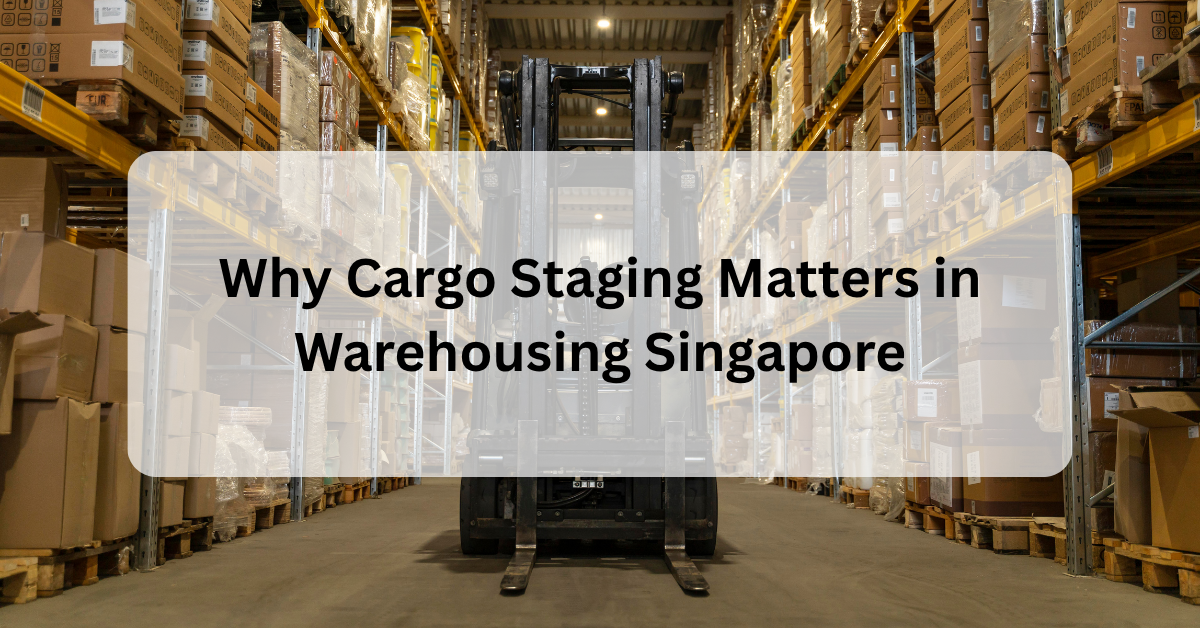

For industrial businesses, warehousing is not simply about finding a place to keep equipment until it is needed. When machinery, components, or project cargo must eventually be packed, crated, transported, and installed, the period between receiving and delivery can be just as important as the journey itself.
This is where warehousing Singapore solutions can play a strategic role. Proper cargo staging allows businesses to inspect incoming goods, organise shipments, prepare equipment for packaging, and coordinate delivery according to project schedules.
For manufacturers, engineering companies, and businesses handling large or valuable equipment, a well-managed warehouse can become an important link between production and final delivery.
What Is Cargo Staging?
Cargo staging refers to temporarily positioning and organising goods before their next stage of transportation, packaging, installation, or distribution.
Instead of immediately sending every item to its final destination, businesses can use a warehouse as a controlled location where cargo is:
- Received and checked
- Organised by project or destination
- Prepared for packaging
- Consolidated with other shipments
- Held until the required delivery date
- Prepared for onward transportation
This is particularly useful when different components arrive at different times but need to be delivered together.
Why Staging Is Important for Industrial Cargo
Industrial shipments are rarely as straightforward as moving standard cartons from one location to another.
A single project may involve machinery, spare parts, electrical equipment, structural components, and other materials arriving from multiple suppliers.
Sending everything directly to the project site can create unnecessary complications.
A dedicated warehouse staging area provides businesses with greater control over when and how cargo moves.
For example, equipment arriving early can be safely stored until the installation team is ready. Meanwhile, additional components can arrive later and be consolidated before the complete shipment is dispatched.
This reduces unnecessary transportation and helps prevent project sites from becoming overcrowded with materials that are not immediately required.
Warehousing Before Wooden Crating
One particularly useful application of warehouse staging is preparing equipment for wooden crating.
Large machinery may require inspection and preparation before being enclosed within a custom-built crate.
During the staging process, the crating team can assess:
- Equipment dimensions
- Weight and centre of gravity
- Lifting requirements
- Fragile components
- Protection requirements
- Final transportation method
Having sufficient warehouse space allows these activities to take place in a controlled environment.
Once the equipment has been prepared, the appropriate wooden crate can be constructed around its requirements rather than relying on rushed or temporary packaging.
Consolidating Cargo Before Delivery
Another advantage of warehousing is cargo consolidation.
Imagine a project requiring equipment from five different suppliers. If every supplier sends its shipment independently to the final destination, the project team may need to coordinate multiple deliveries, unloading schedules, and transportation arrangements.
Instead, cargo can be received at a warehouse and consolidated before the final delivery.
This can help businesses:
- Reduce the number of individual deliveries
- Coordinate transportation more efficiently
- Simplify receiving procedures
- Improve project scheduling
- Reduce unnecessary handling at the destination
For large industrial projects, these improvements can make a significant difference to overall logistics coordination.
Protecting Cargo Between Arrival and Dispatch
Storage conditions matter, particularly when equipment will remain in a warehouse for an extended period.
Industrial machinery and sensitive components may be affected by environmental exposure, dust, improper handling, or unsuitable storage conditions.
Professional warehousing Singapore services should therefore consider the characteristics of the cargo rather than treating every item in the same way.
Depending on the equipment, appropriate storage and handling procedures may be required to reduce exposure to potential damage before the cargo moves to its next destination.
For high-value equipment, this controlled environment provides an additional layer of protection before transportation.
Supporting Just-in-Time Project Delivery
Project schedules can change quickly.
Equipment may be completed earlier than expected, construction work may be delayed, or an installation team may require specific components at a particular stage.
Warehousing provides a buffer between cargo availability and final delivery.
Instead of sending equipment to a site before it is required, businesses can hold it until the appropriate delivery window.
This approach can be particularly useful for construction, engineering, manufacturing, and infrastructure projects where site space is limited and delivery timing is critical.
Singapore’s Role as a Logistics Hub
Singapore’s position as an international trading and logistics hub makes efficient cargo handling especially important.
According to the Singapore Economic Development Board, Singapore has developed a strong logistics ecosystem supported by its connectivity, infrastructure, and position within global supply chains.
For companies importing machinery or coordinating international project cargo, having access to suitable warehousing can provide greater flexibility between arrival and final delivery.
Combining Warehousing With Crating and Cargo Handling
The greatest benefit comes when warehousing is connected with other logistics activities.
For example, a project may follow this sequence:
1. Cargo arrives
Equipment is received at the warehouse.
2. Inspection and staging
The cargo is checked and organised according to the project.
3. Preparation
Equipment is prepared for handling and packaging.
4. Wooden crating
Custom crating is completed based on the cargo’s dimensions and protection requirements.
5. Consolidation
Crated equipment and other project cargo are organised for dispatch.
6. Transportation
The shipment is delivered according to the project’s schedule.
Connecting these stages reduces the need to coordinate multiple service providers and can create a smoother transition from storage to final delivery.
Why Choose Kaibeng for Warehousing Singapore?
Kaibeng provides warehousing Singapore solutions designed to support businesses handling industrial cargo, machinery, and project-related materials.
Its warehousing capabilities complement services such as wooden crating, packaging, machine moving, and project logistics, allowing businesses to coordinate multiple stages of cargo preparation and movement.
This integrated approach is particularly useful when equipment needs to be stored temporarily before being packed, transported, or delivered to a project site.
Businesses can explore Kaibeng’s warehousing services to learn more about its storage and logistics capabilities.
Conclusion
Effective warehousing is not simply about where cargo is stored. For industrial businesses, it can provide the controlled space needed to inspect, stage, consolidate, package, and prepare equipment before its next journey.
With proper cargo staging, businesses can better coordinate delivery schedules, reduce unnecessary transportation, and protect valuable equipment between arrival and dispatch.
For companies searching for warehousing Singapore solutions, choosing a provider that understands the wider logistics process can provide an important advantage. When warehousing works together with crating, packaging, handling, and transportation, it becomes an active part of the supply chain rather than simply a storage location.