
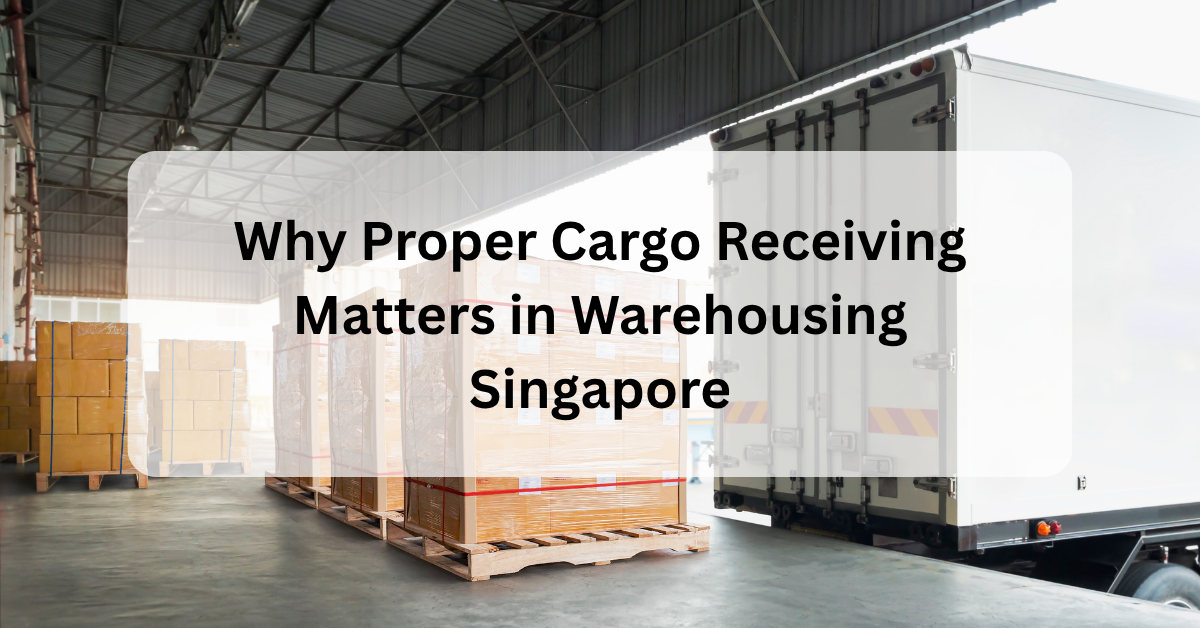

A warehouse’s job does not begin when cargo is placed on a rack or storage floor. It begins the moment a shipment arrives at the facility.
For industrial businesses handling machinery, equipment, components, and high-value cargo, the receiving process can have a direct impact on storage accuracy, cargo protection, and downstream logistics. If goods are incorrectly recorded, damaged during unloading, or stored without proper inspection, these issues can create problems later when the cargo is required for production, crating, transportation, or delivery.
This makes cargo receiving an important part of professional warehousing Singapore operations.
With Singapore continuing to strengthen its position as a global logistics hub, businesses increasingly depend on warehouses that can do more than provide storage space. The Singapore Economic Development Board highlights the country’s strong logistics infrastructure, connectivity, and growing capabilities in specialised supply chain operations.
What Happens When Cargo Arrives at a Warehouse?
Warehouse receiving is the process of accepting incoming goods and preparing them for storage or their next logistics activity.
Depending on the type of cargo, the process may involve:
- Checking delivery documents
- Confirming cargo quantities
- Inspecting packaging condition
- Checking for visible damage
- Recording cargo dimensions or weight
- Identifying individual items
- Assigning storage locations
- Moving cargo to the appropriate area
For standard cartons, this process may be relatively straightforward. Industrial cargo can be considerably more complicated because of its size, weight, value, and handling requirements.
Why Industrial Cargo Requires Greater Attention
Industrial equipment can be expensive, oversized, fragile, or difficult to replace. A warehouse may receive anything from machinery components to complete production equipment.
Examples include:
- Manufacturing machinery
- Electrical equipment
- Precision engineering components
- Industrial spare parts
- Heavy equipment
- Project cargo
- Equipment awaiting export
A damaged exterior does not always indicate the full extent of damage. Sensitive equipment may contain internal components that can be affected by impact, vibration, or improper handling even when there are no obvious external signs.
For this reason, proper receiving procedures help establish the condition of cargo when it enters the warehouse.
Documenting Cargo Condition
One of the most useful steps during receiving is documenting the condition of the shipment.
If damage is identified, warehouse personnel can record relevant details before the cargo is placed into storage. Depending on company procedures, this may include photographs, delivery documentation, packaging observations, and item identification.
This creates a clearer record of the cargo’s condition at the point of receipt.
Accurate documentation can become particularly important when equipment later moves through several stages of the supply chain, such as storage, packaging, transportation, and installation.
Correct Identification Prevents Future Delays
A warehouse may contain hundreds or thousands of individual items. Without proper identification, finding a specific piece of equipment later can become time-consuming.
Receiving procedures should therefore capture relevant information such as:
- Item description
- Quantity
- Reference number
- Project information
- Storage location
- Arrival date
- Special handling requirements
Good identification allows warehouse teams to locate cargo more efficiently when it is required.
For project-based industries, this becomes even more important because different components may be required at different stages of a project.
Handling Heavy and Oversized Cargo Safely
Industrial warehousing often involves cargo that cannot simply be moved manually.
Forklifts, cranes, pallet trucks, and other handling equipment may be required depending on the shipment.
This makes the receiving process closely connected to workplace safety.
Singapore’s Ministry of Manpower identifies forklifts and lifting equipment among the machinery and equipment covered under the Workplace Safety and Health framework. Businesses involved in warehouse operations should therefore ensure that appropriate equipment, procedures, and competent personnel are used for relevant handling activities.
Proper planning before unloading helps reduce unnecessary movement and handling risks.
Receiving Is Also Important for Future Crating
For businesses that store machinery before export or transportation, the receiving process can provide valuable information for future wooden crating.
Once equipment arrives, its dimensions, weight, condition, lifting points, and packaging requirements can be assessed before a crate is designed.
This is particularly useful when machinery arrives without suitable transportation packaging and requires custom protection before its next journey.
Instead of rushing the crating process immediately before dispatch, warehouse teams can coordinate with packaging specialists in advance.
This creates a smoother transition from:
Receiving → Inspection → Storage → Crating → Dispatch
Warehousing as a Logistics Control Point
A professional warehouse can act as an important control point between suppliers and final destinations.
For example, equipment arriving from overseas may not need to be delivered immediately to a project site. It can first be received and stored while the business coordinates transportation, packaging, installation schedules, or other project requirements.
Singapore’s strong connectivity makes this particularly useful for businesses managing regional supply chains. The EDB notes that Singapore provides extensive sea and air connectivity and serves as a base for companies managing regional and global supply chain operations.
The warehouse therefore becomes more than a storage location. It becomes a controlled point where cargo can be checked, organised, protected, and prepared for its next stage.
What Should Businesses Look for in a Warehousing Singapore Provider?
When comparing warehousing Singapore providers, businesses handling industrial cargo should look beyond available floor space.
Consider whether the provider can support:
Cargo receiving: Can the warehouse handle the size and weight of your goods?
Handling: Is suitable lifting and handling equipment available?
Storage: Can different types of cargo be stored appropriately?
Documentation: Are incoming and outgoing goods properly recorded?
Packaging: Can the warehouse coordinate with crating or packaging requirements?
Logistics: Can storage be connected with transportation or project requirements?
Choosing a warehouse that understands the complete cargo journey can reduce the need to coordinate multiple disconnected services.
Kaibeng’s Warehousing Capabilities
Kaibeng provides warehousing services in Singapore for businesses requiring storage and cargo handling support. Its warehousing operations complement other services such as wooden crating, packaging, machinery moving, and project logistics.
This combination can be particularly useful for industrial cargo that needs to move through several stages before final delivery.
For example, equipment can arrive at the warehouse, be handled and stored, prepared for customised crating, and subsequently arranged for transportation according to the required schedule.
Businesses can learn more about Kaibeng’s warehousing services and available logistics capabilities.
Conclusion
Effective warehousing Singapore operations start before cargo reaches its storage location. A professional receiving process establishes cargo condition, improves identification, supports safer handling, and creates a stronger foundation for everything that follows.
For industrial businesses, the warehouse can serve as an important link between suppliers, packaging operations, transportation providers, and final project destinations.
By choosing a warehousing partner with the right facilities, handling capabilities, and logistics experience, businesses can gain greater control over their cargo from the moment it arrives until it is ready for its next destination.